
This is the second half of a talk I gave recently on 40 Years of Activism. Read Part 1.
Something Like a Commitment Ceremony
In 1999, three years into our relationship, Amber and I bought a 1972 Chinook RV that we named Betty. We rented out our homes, arranged for work we could do remotely, and spent 18 months traveling the country. I chronicled our adventures in a monthly column, Travels with Betty, for Just Out, Oregon’s lesbian and gay newspaper.
Not long into our relationship I’d asked Amber if she could ever envision something like a commitment ceremony. I wasn’t exactly proposing to her – but at that point in my thirties I wanted a more intentional relationship than the ones of my youth that went on mostly by default. Amber responded, “Maybe after 5 years!”
Heading back to Portland from our year and a half on the road, having survived living together in a tiny house on wheels that broke down in just about every state we passed through, we agreed to throw a Celebration of our Relationship at the five-year mark.
We invited 120 family and friends to gather with us in the beautiful Columbia River Gorge. The date we set was September 22, 2001. That ended up being 11 days after 9-11 – and, remarkably, 11 days before my dad’s death. Anthrax was everywhere and my family’s nonstop, cross-county flights from JFK, Logan, and Dulles airports were cancelled. But everyone insisted, we need to be together, now more than ever.
Amber and I like to say, we’ve been married three times, all to each other. We hadn’t called that first ceremony a wedding, but looking back we see that magical day as our first.
Stamped “Null & Void”
Three years later in Portland, our County Commission began issuing marriage licenses to same sex couples, following Gavin Newsom’s example in San Francisco. We figured that if everyone was going to be so upset about it, we should drive up the numbers.
We got our marriage license then waited in a rowdy line at the next door Lucky Lab Brew Pub where a former softball teammate of Amber’s was officiating assembly line pronouncements from behind the bar. Later, after voters approved a statewide ballot measure banning same sex marriages, our marriage license – and those of 3000 other couples – was returned, stamped null and void.
By 2014 when the US District Court legalized same sex marriage in Oregon, and 2015, when the Supreme Court made the same decision nationwide, I had become deeply involved in the fight for marriage equality.
Stories of Love & Commitment
A friend and colleague I’d met on my very first campaign, Thalia Zepatos, had continued to research and experiment with the question of how to build majority support for lesbian and gay rights. She had joined the national campaign led by Freedom to Marry and had come to be known as the movement’s messaging guru.
Through focus groups and polling she discovered that swing voters didn’t think that “rights and benefits” were legitimate reasons to grant marriage to same sex couples and our children.
Because straight people generally didn’t think of themselves as getting married in order to secure rights or benefits, they were susceptible to rightwing propaganda that said gay people were looking for “special rights,” and were trying to hijack the institution of marriage for our own political agenda.
It turned out that if we shared our stories of love and commitment, our desire to take care of our families, swing voters realized – Oh, those couples aren’t so different from us. They want to marry for the same reasons we do.
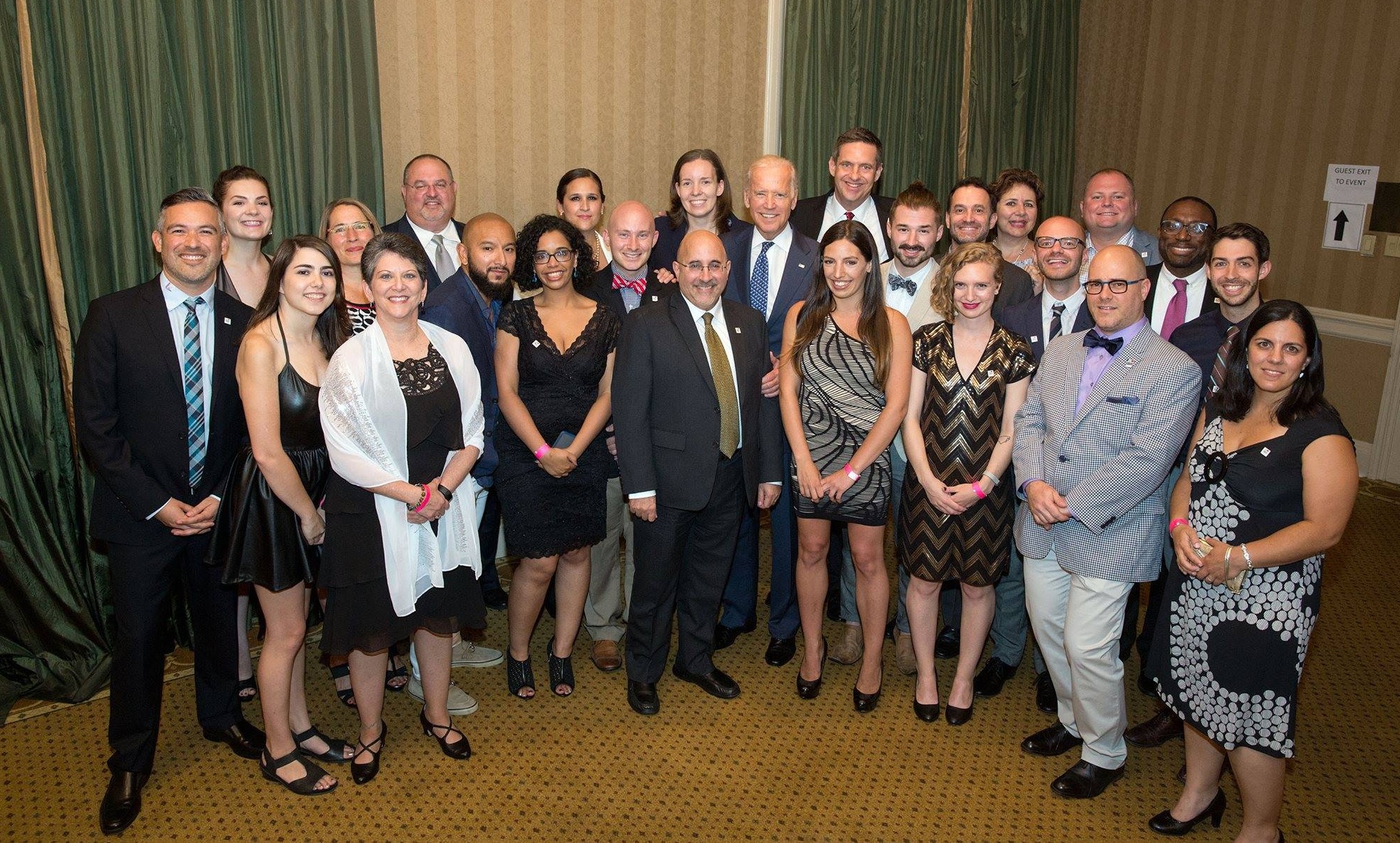
Thalia brought me onto Freedom to Marry as a consultant for the last five years leading up to the U.S. Supreme Court decision. I got to work with scores of couples from across the country, helping to tell their stories of love and commitment – in community meetings, to editorial boards, and on tv and radio ads.
Watch a beautiful 6-minute video that recounts this remarkable piece of history that was years in the making but finally arrived, as President Obama notes, “like a thunderbolt”.
Belonging & Connection
During that same time I had become a wedding officiant. When the path was cleared in Oregon by the court ruling, I had the privilege of officiating the very first ceremonies, in front of national news cameras. The Portland Mayor was waiting in the wings to officiate the next batch and asked if he could use my script.
Later Amber and I asked Thalia to officiate our third and final wedding ceremony, a small gathering in our back yard.
Becoming a wedding officiant was just one aspect of a major turning point in my work life that took place about 15 years ago. I loved my work as a consultant, but it was mostly focused on winning or defeating legislation, fighting for a bigger slice of the budget pie, trying to shift public opinion. Really big picture stuff, and I was generally pretty behind-the-scenes.
I found myself longing for work that could be called more cultural than political – how we make meaning from the changes and hardships in our lives, how we build a stronger sense of belonging and connection.
It was a random stroke of fate that introduced me to the emerging field of civil celebrancy. Civil Celebrants were first recognized in the 1970s by the Australian government as a profession that could marry and bury people, outside the clergy and judiciary.
Devoting myself to creating ritual and ceremony was a case of teaching what you need to learn. When my dad died around the age I am now, there was no funeral or memorial. After 18 months of illness and dying at home under hospice care, he was zipped into a body bag in front of me and taken off for cremation. A few weeks later I got a portion of his ashes in a yoghurt container and some mementoes of his life from my step-mother. It took a few more months for me to realize I needed a grief ceremony of some kind, which a friend helped me create. It wasn’t until 10 years later, as I trained to be a Funeral Celebrant, that I wrote my father the eulogy he’d never had.
Remembrance & Bereavement
Embarking on my new calling as a Celebrant, I had the privilege of co-creating meaningful, personalized ceremonies for an incredible array of situations – weddings, of course, but also divorces, new baby blessings, house clearings, honorings of retirements and the closing of a family business, the turning of the seasons. The bulk of my practice has focused on funerals, memorials, celebrations of life, and related rituals of remembrance and bereavement.
Some of these have been high-profile, like the Celebration of Life I officiated for Packy the Elephant, the oldest male Asian elephant in North America when he died at age 54. He’d been a national celebrity all his life, having been the first elephant born in the Western Hemisphere in 44 years.
The ceremony that honored him was attended by all the local VIPs, and watched online by tens of thousands worldwide.
I also had the chance to work with the Oregon Zoo on a reinterment ceremony for the remains of nine unidentified people that had been inadvertently dug up during new construction. It turns out, the Zoo is located where the County Poor Farm had been 100 years prior.
Four years ago next week, a woman I’d known for years in Portland’s lesbian community – she went by the name Amazon back then – was killed in circumstances similar to Renee Good, in the midst of a racial justice protest. But it wasn’t an officer who shot her, it was a radicalized counter-protester. I helped with the community vigil that mourned her death.
One of my greatest honors was working with Linda Campbell, and later, her family, on the burial of her wife Nancy, and later Linda’s own burial. Linda was a retired Air Force Lieutenant Colonel who won the right for same-sex spouses to be buried in a national cemetery.
The Power of Community
Of course, most of the families I serve are not the subject of news stories. Some of them are honoring expected deaths at the end of a good life, some are mourning babies or children who didn’t make it, some are suffering the shock of suicide, overdose, accident, or violence, or the anguish of deaths that feel “before their time,” or perhaps long-overdue, in the case of dementia.
People say, that must be depressing! It’s the same thing they said during my years working against domestic and sexual violence.
Yes, the prevalence of abuse and injustice is distressing – and so is the suffering that can accompany dying and grief. But I’ve been fortunate to be one who holds up the mirror, so that what’s reflected back is not just the abuse or the disability or grief. What’s reflected back is the strength and courage and incredible human spirit of people who stay human through dehumanizing circumstances, who find a way to love themselves and life enough, to find a way forward, without knowing how.
That witnessing can happen one-on-one – and even more powerfully, in community. I’ve found a number of ways to combine the community organizing of my 20s, 30s, and 40s with my newer focus on life’s major passages.
For example, when the Michigan Womyn’s Music Festival was approaching its 40th and final year, I was invited to co-create and lead a Celebration of Life, a kind of wake or living funeral, with the Festival worker community.
Last summer, 10 years after the final Festival when workers gathered on the Land for a reunion, I led a remembrance ceremony where we called the names of women who had gravitated to the Land in that earlier era who are now among our ancestors.
Democratizing Access to Information
As I was starting out my work as a funeral celebrant I heard about a new conversation format called Death Café. When I organized the first in Portland, 100 people showed up. Over the next 8 years we came to be known as the largest Death Cafe in the worldwide movement.
Death cafe is simply a time to sit with others and share whatever is on your mind about death, dying, and grief – no agenda, no presenters, just permission to talk about what, for many, is still a taboo or unwelcome topic.
Death Cafe is part of a social movement to democratize access to information and support when it comes to the one thing we all have in common – that we are mortal, and that we and everyone we hold dear will die.
There’s a role for the professional support of funeral directors, therapists, and clergy people, for many. But throughout human history, family and community has always cared for each other in death as we do in life.
Home funeral guide, death midwife, end-of-life doula are some of the terms for those of us outside the medical and funeral professions who are helping to restore the knowledge of how to care for our dying and our dead, in those parts of the dominant culture that have lost that ancestral knowledge.
One of the most consequential calls I’ve gotten in this work was from a bereaved mother whose 4-year-old son had drowned in their ice-covered ranch pond while the babysitter was focused on his younger brother. After Max was life-flighted to the nearest hospital, and the death investigation was completed by the medical examiner, his parents were blocked from bringing his little body home to be buried in the family cemetery on their ranch. This was their legal right – only the medical examiner, the hospital, and the funeral director who took custody of his body were ignorant of the family’s rights under Oregon law.
A year later Max’s mother found me. We recruited a team to create Oregon Funeral Resources & Education, a public information website on family funeral rights. We had it reviewed and validated by longtime funeral directors and medical professionals, including the state’s Chief Medical Examiner – who apologized for the mistake that had been made, and updated the state’s annual medical examiner training with our input.
We went on to make sure the hospital updated its policies and have since influenced the training and policies of other hospitals and hospice organizations.
Carrying the Hard Things Together
So these days I’m still an activist, still out with my neighbors protesting injustice. But I’m also something of a rites-of-passage activist, doing my part to ensure that we have agency and connection, and that our rights are respected, through these meaningful moments in life and death.
I used to have some really grandiose convictions that we could fix everything, save everyone, right all the wrongs. Smash the patriarchy. End racism. Now I have a bit of a longer view.
The Portland grief activist Megan Divine says, “Some things can’t be fixed, they can only be carried.” And we can help each other with that, with carrying what is too heavy to bear alone.
I see that happening every day in the work I’m honored to do.
Read Part 1: 40 Years of Activism
Photo: Staff of the Freedom to Marry campaign (led by Evan Wolfson, front row center) celebrating the Supreme Court ruling with Vice-President Joe Biden, July 9, 2015. (Thalia Zepatos, back row fifth from right; Holly Pruett back row third from left.)
Caveat: As they say on The Moth Radio Hour, “Moth stories are true as remembered and affirmed by the storyteller.” Read more about the benefits and challenges of historical memory, from No on 9 Remembered.